Monday, March 3, 2014

Poland


Workshop 63 just returned from a week in Poland! We had two seminars leading up to this trip in order to prepare ourselves. One was at our house in Akko and was just with my kvutza, and the other one was at Lohamei HaGeta'ot, the Ghetto Fighter's Museum and was with the other kvutza too. We learned a bit about the Jewish resistance during the Warsaw Ghetto Uprising, the difference between extermination, transit, labor, and concentration camps, and also talked about expectations for our kvutza during the trip, how we can be a support for one another, and talked about how this is actually a journey, not a trip. Having these seminars really made me feel ready to just go to Poland already, and begin learning and seeing these things that we discussed in person.

 On Saturday, February 22nd, my kvutza took a bus to the airport that stopped in Haifa to pick up the madrichim, and then to Rishon LeZion to pick up the other kvutza. We ended up getting to the airport around 2:45 for a flight that left at 5 AM, so we were all exhausted by the time we got on the airplane. I guess it's a good thing to be exhausted for a plane though. I fell asleep the second we took off. Packing for Poland was fairly easy to my surprise... I just threw in all my warm clothing and I was set. It wasn't as cold as I thought it would be in Poland, but nevertheless after being in Israel for 6 months, I was not used to cold weather. However, it did remind me of home which was nice though.

Once we landed, we took a long bus ride to Krakow and explored the Jewish section of the city. We went to a few museums, peered into an old, yet beautiful synagogue, and heard a guest speaker. Paulina, the speaker, is an old Polish woman who spoke no English (we had a translater though) and wore traditional Polish garb. She told us about her family in the wake of the Holocaust, and how they risked their lives to help many Jews. Her family was Catholic, but they still helped feed hungry children who came to their doorstep, and assisted in driving Jewish families to bunkers for hiding. It was amazing to hear her story and learn about some of the valiant efforts that her and her family made in order to save the lives of some of the Jews in Krakow. After a long, long first day, we drove to the hotel in Krakow, had dinner, a peulah, and then went right to bed.

The next day, we woke up at 6:30 AM (every day of the trip we woke up around the same time), had a nice breakfast at the hotel, and then went on an hour bus ride to Auschwitz-Birkenau. One of the first things I learned is that there is a difference between Auschwitz-Birkenau and just Auschwitz. Auschwitz has sub camps, and Birkenau is the forced labor and extermination camp, and Auschwitz was the concentration camp. Birkenau was incredibly difficult for me, and most of the rest of workshop. I've learned about Auschwitz for many, many years now, but being there was something different. Seeing the crematoriums, gas chambers, barracks, and railroad tracks was just hard and knowing that I saw these awful, awful structures in person was crazy. Next, we went to Auschwitz, which is where the sign that says "Arbeit Macht Frei" hangs before you enter. Auschwitz looked like nothing that it imagined it to look like. There were numerous stone buildings that were actually pretty nice looking on the outside. Inside some of the buildings were exhibitions, like items that belonged to the Jews such as the piles of shoes, piles of hair, and prison cells that were used for prisoners.

We went to two more extermination camps during our time in Poland, Majdanak and Treblinka. Majdanak doesn't have any more original buildings, but there were barracks and other buildings that were recreated to model what the camp did look like during the time. What's awful is that there are houses that sit right across the street from the camp. It's crazy that these people are so desensitized that they can live so close to such a horrible place. Majdanak has a memorial in the back of the camp by the crematoriums that is filled with all the ashes of the people who died there. It's literally just a giant clump of ashes, all thrown into this giant dome structure.

The day we went to Treblinka was the hardest day out of all the days. We went to Tykocin, a small town which used to be a Jewish town. The Nazi's forced all the Jews there out and took them to the nearby Lopochova forest and shot them all. We went to Lopochova after Tykocin and got to see the small memorial that was set up for those who perished there. It was emotionally difficult to be standing in the middle of a forest where hundreds and hundreds of Jews were just mass murdered. Next we went to Treblinka, which is nothing but a memorial for those who died there now. There are a bunch of concrete planks to symbolize the train tracks that lead up to the memorial, which is thousands of stone structures that represent the people who died. We calculated that each stone represents about 48 people, and there were THOUSANDS of these stones.

We also got to go to a once Aryan-only street when we were in Lublin. We learned about the difference between the SS, SD, Gestapo, Order police, and the Wehrmacht.

In Warsaw we went to a vast Jewish cemetery with thousands and thousands of gravestones. We were told to look out for our last names or our family names on the graves. I separated a bit from the group to explore, even though I wasn't supposed to. It was very calming to be walking in the cemetery by myself for a bit. Although it wasn't that much time, I was able to do some self reflecting which is something that I hadn't found the time to do in Poland before. Going from place to place with 17 other people in my kvutza is very difficult. I'm constantly around other people, and for some of these things, being around that many people is just overwhelming. I found myself needing time for myself a lot, and it wasn't easy to get that without separating a bit. I also went by myself when we were at the memorial with all the stones at Treblinka and Lopochova forest. Being surrounded by nature allows for some really good thinking time, without much interference from others.

We went to Plaschow concentration camp when we were in Krakow. It's literally in Krakow, the second biggest city in Poland. It's hard to believe that a concentration camp can be right in a city.

In Warsaw, we went to where the ghetto once was. We saw an original building that is still standing from the ghetto. What's crazy is that there are apartments right on the other side of the originally wall of that building.

We also went to the building that was  Januscz Korczak's orphanage. Korczak was Jewish man who was the director of an orphanage and refused freedom and stayed with his children when they were sent to Treblinka. Subsequently, he went with them and even followed them into the gas chambers, where he, and his children died.

The last day we learned about the youth movement resistance fighters like Mordechei Anielwicz, Chavka, Zivia Lubetkin, etc and their efforts in the Warsaw Ghetto Uprising. We walked the path of heroes and listened and learned about their stories.

Three times during this journey to Poland, we were given some money and allowed to buy our own lunches. The first time was in Krakow and it was really nice to walk around outside and go to a restaurant or cafe of our choosing. I went with Liat and Lindsey to a cafe on a side street a bit out of the way of the main square in Krakow. It was called the Botanical Cafe and it was so cool inside! We sat on couches in dim lighting with lit candles on our table in the front of the cafe, but in the back of the cafe (which was actually very large) there were roof windows that brought in natural light. The whole cafe was super artsy and had these ornamental leaves and trees growing out of the ceiling and walls. I ordered penne with pesto and some Polish cheese. After we were done eating, we went through the market in the square and looked at little trinkets and jewelry, and then spent the rest of our time people watching. The second and third times we could get our own lunches weren't as great as the first, yet I still enjoyed being able to walk around and explore a bit.

Some little things:
It was foggy most if not all of the days were in in Poland. It really set the eerie, depressing mood for the things we were doing and experiencing.

Each day members from my kvutza would pair up with members from the other kvutza and prepare a short tekes (ceremony) that would wrap up the day. People would read poems, sing a short song, share a speech, etc. My tekes group was for when we went to Treblinka. I read a short poem, while others in my group asked some thought-provoking questions to the group, recited another poem, and gave a speech.

At the beginning of each day on the bus, the madrichim played a song and we would all dance to it together. It was fun.

The bus that we traveled on had a bathroom in it, but we couldn't use it or else we would be traveling around in a bus that smelled like bathroom for the duration of our time in Poland. We had to either pee in bottles, hold it in, or drink water in the last half  hour of the bus ride. Some of the bus rides were very long (we traveled all around Poland in a matter of a week) but we did stop during the longer bus rides for a bathroom break. Some of the public bathrooms charge 1 Zloty which was annoying, even though its only like 35 cents in US dollars.

Polish is a very interesting language. There are so many consonants in the words. I learned how to say Hi, Excuse Me, Thank You, and Have A Good Day. Being in Poland made me realize how much Hebrew I know though, and when I got back to Israel I felt a lot more comfortable since I was able to read signs and talk in the same language as the locals again.


Some pictures:


Some airport fun waiting for our 5 AM flight to Warsaw.


Krakow

Auschwitz-Birkenau


Railroad tracks at Auschvitz-Birkenau


Railroad car at Auschvitz-Birkenau

Inside the barracks at Auschvitz-Birkenau


Plaschow concentration camp monument 

Pizor time in krakow 


Krakow Pizor time again


And again

Krakow tourist market

The food that Liat, Lindsey, and I got

Inside of the café

Still standing, original building that was from the Warsaw Ghetto

Jewish cemetary in Warsaw

Warsaw architecture 

Downtown Warsaw

The last night we went to a restaurant with traditional polish dancing

Thursday, January 23, 2014

Lately on Kaveret

Lately on Kaveret:

Our kvutza has recently gotten a lot more musical. Many of us are learning to play the guitar. We also found a keyboard at the house when we arrived and got it to work! There's also a really cool place about a 15 minute walk away right next to the beach called HaJam (הגים). Every weekend local bands play, there is karoeke night, or open mic night. On the first Saturday of each month, admission is free! We've definitely been taking advantage of this place because it's not only in an awesome location or a great place to listen to music, but it's also a great way to meet new people! Some of us have also started to busk around akko. We've brought our musical instruments like the saxophone, flute, and of course our singing voices! We have made around 150 shek which is awesome! 

A few weekends ago some people from the other kvutza came to visit our house! We showed them around Akko and took them to the old city. It was nice seeing them again.

There has also been 2 birthdays this past week! Jacob and Asher both turned 19 and so of course we have celebrated with cake! 

Jacob's cake
Asher's cake

I also work at Tichon HaChevrati with 2 people on shnat sherut who live in Akko. They are on a program similar to ours: they live in a house together and volunteer at similar places. They do this for the year before they go into the army. Their kvutza is only 10 people, but they all come from different places in Israel just like how we come from all over North America. On Wednesday night, Niv (who works with us at the school in the morning) invited us over to hang at their house. I'm glad we're starting to meet people who live in Akko. It's a nice way to become more integrated in Israeli society. 

We've also been preparing for our big Poland trip in Febraury. Last weekend we had a seminar at our house that included many peulot, and a lot of sitting in one location for a long time. It was very interesting, but by the end of the seminar my brain was literally fried. Well maybe not literally, but I was super tired.


Tuesday, January 14, 2014

Messima

Right after chofesh ended, we started messima! We do messima on Sundays, Tuesdays, and Wednesdays. We go to the school in the morning on Sundays and Wednesdays, and the after school ken on Sunday, Tuesday, and Wednesday. Tuesday morning we have Yom Tzevet, a morning set aside to plan activities for our kids and to have peulot and discussions run for my tzevet by our melavim, Sarah and Adam.


 On Sunday, January 5th, Sara B, Chief, Ari, and I all woke up very early. We left the house by 7:15 AM to catch a sherut (a shared taxi) to Kiryat Ata, where we caught a bus to the school, Tichon HaChevrati. Tichon HaChevrati is an alternative school, similar to the democratic school system that exists in the United States. It's a very simple school, with only a few classrooms and with no more than 30-35 students. Students take English and math, and every Wednesday there is chuggim for the first class of the day. There's also a "teacher's lounge," but because of the school's value of no hierarchy between teachers and students, the students are allowed into the lounge. Most of the students hang out outside on the benches talking with one another, playing basketball on the court, or in the living room, which has food and coffee/tea for them to have. The schedule of the day is also fairly simple: school starts at 9, first class, break, and then another class. Most times they also get a break in the middle of each class as well. I would say that Wednesday's are my favorite at the school. All 4 of us choose which chug we want to go to. Sara and I have gone to art the past 2 Wednesdays, Chief to acrobalance, and Ari to music. At first it was difficult to figure out the role we were supposed to play at the school. There's already teachers there, and it seems to me like everything could and has been running just as smoothly without us being there. However, our role is very important. We're older than them, but not by much (they're 9th-12th graders), but we're still younger than the teachers, so it's easier to connect with us. Although it's a hard for most to understand our English, it's important for us to hang out and talk to them during the breaks. Most look up to us and have been expecting us for a while now. Our biggest role though, is to help and tutor in their classes. I've sat in both English and math classes, and it's really helpful for the students to have one on one help. Most classes are also very small, with no more than 10-12 students.


Once the school day ends at around 2, we take the bus back to Kiryat Ata and then switch on another sherut that takes us to Hadar in Haifa. From there we walk to Beit HaTziorim, the after school ken. It's completely different from the school we volunteer at in the mornings. First off, it's in a bomb shelter, so that's pretty awesome. We also work with 4th-6th graders who are of all different ethnicities. There are Russian Christians, Russian Jews, Arab Christians, Arab Muslims, and Israeli Jews. Most of their parents are immigrants who came to Israel, and because of that their native languages are not Hebrew, but instead Russian or Arabic. Most of the kids speak Hebrew though. I find myself using my hebrew a lot more at the ken instead of the school in the morning. I'm learning a lot of Hebrew, and being able to use it and understand some of what the kids say  feels amazing, especially from the place I was in the beginning of the program. So usually when we get to the ken, 1 or 2 of us help out with homework, while the other members of my tzevet play outside with the kids. They love playing games like hide and go seek, dodgeball, soccer, and tag and so I get a pretty nice workout running around and playing with them. Since there is a high school right next to the ken, there is a soccer field/ basketball court that we can use too. At 4:30, the kids go inside for a snack. It's the same thing every day: toast with either hummus, lavna, or tuna, and tons of different kids of vegetables! What's really neat is that the kids learn how to be responsible for themselves, and so a great way to do that is by preparing the meals and cleaning up after themselves. Usually one or two of them prepare with the help of a madrich and then they hand wash the dishes after the meal is over. On Sundays and Tuesdays the kids have chuggim, which include ping pong, singing, art, cooking, and dance. On Wednesdays they split up by grade and participate in an activity run for them by madrichim, which will start to be us in a week! 

It took us some time to get used to the routine of the ken, but now since it's been about 3 weeks, we are pretty comfortable with the schedule and with the kids. I'm excited to start running activities and to continue building a relationship with the kids we work with! 

Messima is a very important part of the workshop program, and an even bigger part of Habonim Dror as a movement. A lot of the Habo's who have made Aliyah to Israel who now live in Haifa volunteer at schools as part of their messima too. Messima is an incredible opportunity for us to not only be madrichim, but to also practice our Hebrew, work on a tzevet to plan activities, and learn to be more responsible as the young adults that we're becoming. 

Two of the girls at the ken playing hand games
Musical chairs!


Sunday, January 12, 2014

Chofesh

It's been a while since I've written a blog post so, apologies. I've been incredibly busy here on workshop. After we moved into our kaveret house in Akko, we had a week long orientation seminar where we were introduced to the second half of our program which includes messima, the volunteer work that we do in schools and after school kenim. After the orientation seminar, we had a much needed chofesh (break) from programming. Many parents, friends, and other family members came to Israel to see their children here on workshop! My mom came, and we traveled around Israel together, mostly in the north. It had been about 35 years since my mom had been back to Israel, so it was both great for my mom to see me, but also for her to come back to a place where she had experienced so much (she lived here in 10th grade and was also on workshop when she was my age!). 

On Saturday, December 21st at night, chofesh began, but my mom wasn't arriving until the next day. 8 of us decided to walk around Akko since the rest of our kvutza was already with their parents. We went to one of the fortresses on the far end of the old city and sat on top of the ramparts. It was probably not the safest thing to do given that we were pretty high up, but we were very safe. We were able to look out at the Haifa Bay and see Haifa, which was beautifu. Afterwards, we got falafel/shwarma and then walked back home. I then packed my suitcase for the week, and then went to bed. I could hardly sleep though. I guess I was just really excited to see my mom and finally be on chofesh.


So the week went like this:

Sunday- I woke up super early. Like I'm talking 6 AM early. I sat around for a while before heading to the airport to meet my mom! We then went to our hotel in Jerusalem, dropped our bags, and then went out to get some dinner.

Monday- We woke up pretty early so that we could fit the most into our first day together. The breakfast at the hotel was amazing. There was so much food that it was honestly a bit overwhelming. There were a lot of vegetables, which I knew was typical of an Israeli breakfast, but then I saw a bunch of random foods like pasta and fish that were also there and that I didn't think were breakfast foods. We then went to the old city of Jerusalem, with the intention of going straight to the Kotel, but we ended up going through the Christian quarter and got a bit lost. It was totally fine though, because the shuks were incredible and resembled a super long, confusing maze. There were so many little alleyways and shops filled with fresh pastries, scarves, and jewelry. The best part of the day was when we stumbled across the Church of the Holy Sepulchre, which is thought to be the site where Jesus was crucified. When we walked in, we were amongst many tourists, almost all of whom were devout Christians making pilgrimages to the church. We heard all different languages: Hebrew of course, Chinese, Russian, English, and some other Eastern European languages that were probably Polish or Lithuanian or something. The church inside was beautiful, like literally the most amazing architecture I've ever seen. There were so many chambers with incredible artwork and stained glass windows, and holy shrines filled with sacred water and places for people to pray. My mom and I just sort of wandered through the church, and while we explored a lot of it, there was still so much we weren't able to see. Once we got out, we did end up finding our way to the Kotel. We weren't too set on going up to the Kotel, as we're both not too fond of it. 

Some things I witnessed: the men's side is a lot bigger, has tables for studying, and the bathrooms are only for the men. The men are respected more. It's sort of a shame that there is so much gender inequality.

After visiting the visible part of the Kotel above ground, we went to the underground tunnels where you can actually see more of the Western Wall. Most people don't realize that a good portion of the wall is underground. It was really interesting learning about the history of Jerusalem, but after a long, long day, we both headed back to our hotel. Later on, we went out for hummus at Hummus Ben-Sira, which probably served one of the most amazing hummus dishes I've ever had. 


Tuesday- Again, we woke up super early. We then went to Tel Aviv and visited Shuk  HaCarmel and an arts and crafts fair, which sold beautiful, yet super pricey hand-crafted jewelry. Later on in the day, we walked along the beach and saw the sunset. It's crazy thinking that it was late December and I was at the beach, walking around in mid 70 degree weather. Our hotel was also amazing. It was a cute, little boutique hotel called Hotel De La Mer, and it was literally right by the sea. 

Wednesday- When we woke up, we went to Neve Tzedek, the first Jewish community in Tel Aviv. We then walked along the promenade towards Tel Aviv port. It was really nice just enjoying the beautiful weather and soaking in some Tel Aviv sunshine before heading north later in the day. In the early afternoon, we headed to the airport to pick up our friend Carole. Once we met up with her, we drove all the way up the coast to Moshav Liman, a really nice moshav right below Rosh Hanikra. Some of her best friends live there, and they invited us into their home for the next few days. 

Thursday- We woke up to one of the best breakfasts I've had on workshop so far. We had omelette and the best, freshest rolls with chocolate spread. There was also banana milkshake and Choco Besakit to drink! We then went to Kibbutz Kfar Blum located right below Kiryat Shmona. My mom lived on this kibbutz during 10th grade during the Yom Kippur War. While we were there, we ran into her host father! He invited us in for tea, and both my mom and him reminisced together. It was also really nice for them to catch up on all these years that they were apart from each other. After Kfar Blum, we went to the Na'ot factory on a kibbutz nearby, and then headed to yet another kibbutz, Kfar Haruv. This is the kibbutz that Carole lived on when she lived in Israel, and so she showed us her old house, and introduced us to some of her good friends. We stayed the night at their house, which overlooks the entire Kinneret.


Friday- We went to Hamat Gader, a bunch of natural hot springs that sit right next to Jordan. On the way back to Moshav Liman, we drove through Tiberias and then stopped in Tzfat. We then drove to Adamit Park to watch the sunset and walk around. It is located on very high elevation, so the view was amazing. Right before we went back to the moshav, we went to Betzet Beach to continue watching the sunset. We then went back to Chana and David's house on the moshav for dinner. There was so much food to go around once again, and it was extremely difficult to not want to eat it all. Their entire family (all of whom live on the moshav as well) came together for Shabbat dinner. 


Saturday- My mom and I said goodbye to Chana, David, and Carole, and went to Akko to explore the old city. I showed her around my house and introduced her to some of my friends who were at the house already. Even though I now live in Akko, it was my first time being in the old city. There were so many beautiful mosques, a Turkish Bazaar selling scarves, coffee, and tea, the outdoor market which is essentially your typical shuk, and many hidden little alleys. My mom and I went through some underground tunnels and then walked around to the lighthouse and the ramparts. It's a shame that we went on a Saturday, because we would have loved to explore some of the museums in Akko. We still had a great time though, and I could not be happier to be living in such an amazing city! After a long day, we went to Haifa and checked into our hotel, which is situated on Mt. Carmel and overlooks the entire city! I could even see Akko out of the window in our room!


Sunday- We went to the Clandestine Immigration and Naval Museum and learned about the difficulties that Holocaust survivors faced when trying to immigrate to what is now Israel. At the time, the British controlled the land and set a quota for new immigrants. The Jews retaliated, and war broke out. Many Jews were forced to return back to their home countries, and many ships were sunk by torpedoes and missiles. Afterwards, we went to Elijah's Cave because we thought it would be cool to explore. It wasn't actually that interesting, but we met a very religious man with a shofar who gave blessings for people to visited the holy site. On our way back to our hotel it started to rain, so we decided to take cover in a cafe and get some dinner. We decided to walk all the way back to our hotel from the cafe. It took a long time, but it 1) stopped raining and 2) we got exercise and it was uphill! 

Monday- It rained a lot on the last day that my mom was here, but we still decided to walk around. We explored Hadar some more, and walked to Wadi Nisnas and then to the German Colony which is right below the Bahai Gardens. Later on when it stopped raining, we were able to walk into the Bahai Gardens, which were beautiful. We then went back to the hotel, packed our things, and then said goodbye to each other at the train station in Haifa. It was really sad saying bye to my mom, but I know that we'll both come back to Israel again and explore more of the country together. 

When I got back home to my house in Akko, I went to bed for I knew that the next day I would be staying up pretty late (it was New Years). 

For New Years Eve, those of us back at the house took the train to Tel Aviv where we met up with a bunch more workshoppers from both our kvutza and the other one, and their parents. We all had dinner at a Yemenite restaurant called Maganda. It was nice reuniting with my friends after not seeing them for a week and being able to see my friends from the other kvutza was also really, really nice. After the dinner a bunch of us went back to the house in Rishon where we stayed the night.

I had a really great chofesh! I've traveled around the country on MBI and on workshop as well, but it was really awesome being able to do it with just my mom. 

Some funny things I realized while on chofesh: Israel is small, which means that I see people I know like everywhere. We saw the Kravinsky family at the Kotel and I saw Bekah from the other kvutza at the airport. I also ran into a girl from school at the beach in tel aviv, and a group from our synagogue at an arts and crafts fair in tel aviv as well!

When you wave down a taxi and they look like they are going to drive right by you, they actually do stop. However, they do it so suddenly. That being said, taxi drivers are insane (and also super impatient). In the event that they are able to have more than 50 feet of space in front of them  with no cars, they will accelerate super quickly to fill the gap.

Israeli hotels, or at least the ones we stayed in, serve such good breakfast included in the price you pay for the hotel. We got so much selection. There were so many vegetables, fruits, pastries, yogurts, cereals, and even foods that you wouldn't normally think of having for breakfast: fish, pasta, potatoes with cheese, pizza, etc


Wednesday, December 18, 2013

Akko!

We've finally moved into our house in Akko! It's pretty small (it's meant for one family), but somehow we managed to fit 18 of us in this one house. 

This is what the house looks like when you first walk in. Through the door to the left you have the kitchen, 2 bathrooms, and one bedroom. To the right you have the entryway to the living room (which we call our moadon), and through the living room you can get to another bathroom and 2 more bedrooms.


This is our kitchen! We finally have a real stove, and a nice, fully functioning refrigerator. We also have a pantry full of dozens of spices, pasta, different spreads, and an array of fruits/vegetables!


Here's our living room/moadon! This is where we do most of our asephot/peulot.


This is my bedroom! I share a room with 4 other people. Sam from Miriam, Jess from Galil, Jacob from Miriam, and Chief from Gesher. I have top bunk, and it's very cramped in our room, but it's got a warm, homey type of charm to it that I like.

If you walk up these stairs, you'll get to the 2nd floor, with 2 more bedrooms and 1 more bathroom. 

This is the central part of upstairs. Here is where we keep the dryer to dry our clothes (the washing machine is downstairs, don't ask why, because I really don't know why they're separated).

Through this window you can see our balcony! And the beautiful sunsets!


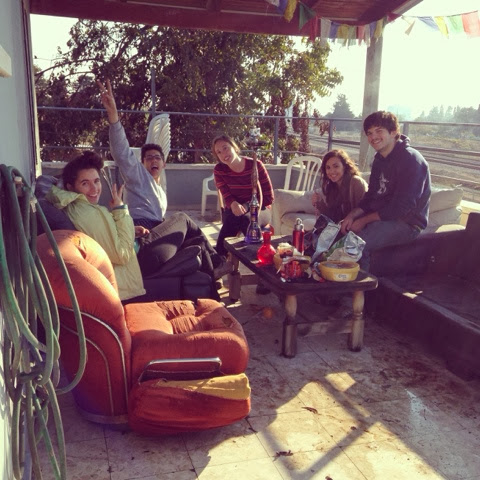
The best part of the house is definitely our wrap-around balcony! As you can see, everyone else is very excited about it too! We get the best views of the sunset, and we live right next to the train tracks that separate us from the main city of Akko. So we live super close to everything, which is awesome! 

What's nice about living in Akko is that we can walk to just about everything we need in the city. It's a lot warmer here than it was in Ein Dor, which makes walking a lot more pleasant. A few days ago we split up into groups and did a short scavenger hunt. We saw the shuk that so many people have told us about. It's full of so many fruits and vegetables! There's also a super cheap grocery store nearby that's cheaper than the kolbo that was on kibbutz. 

Today we went out for lunch as a kvutza. We went to this hummus and pita place and all sat down on a super long table. They kept on giving us so many different kinds of hummus like hummus with chick peas, hummus with beans, hummus with tahini, and regular hummus. It was so good, and we all left feeling super satisfied. 

After lunch, we still had 2 hours to kill before our next peula began. 7 out of the 9 of us girls decided to walk to the beach! It was amazing being able to go to the beach in the middle of December! I could even see Haifa across the bay! 


Another part of kaveret, and probably the most exciting and important, is messima. Messima is the work we will do in schools with Israeli Jews, Arabs, or both. It was a super long process of deciding the tzvatim and choosing where we want to work (there were 4 options), but after a night and a morning of discussing, we finally figured it out.  

I'm working in Haifa at a school with mostly Jews. In the afternoon, my tzevet, (which is Sara Banai, Ari Egar, Chief, and myself), will be working in the ken at Beit 
HaTzeirim. I still don't know the specifics of the messima, but I'm still super excited. Haifa is my favorite city in Israel, and I can't wait to finally be a madricha.

Soon it'll be chofesh for workshoppers, which means that we have a week or so off from programming.